ArticleOpen AccessCover article
A complete census of beerhouses in Lixia District reveals a spring-driven night-time consumption geography
Ground-truthing of 412 beer-serving venues across Lixia District, Jinan, shows that a one-kilometre buffer around the spring clusters holds three-fifths of supply. An old-town barbecue belt and an eastern craft-beer belt form a stable dual core.
Bochun Zhang1,2*†, Shuyao Lin3*, Chengyuan Ma4†, Yinan Zhao5, Guyan Chen6, Ken Sato7
* Equal contribution · † Corresponding author
B.E.E.R. 647, 221–234 (2026)
Abstract
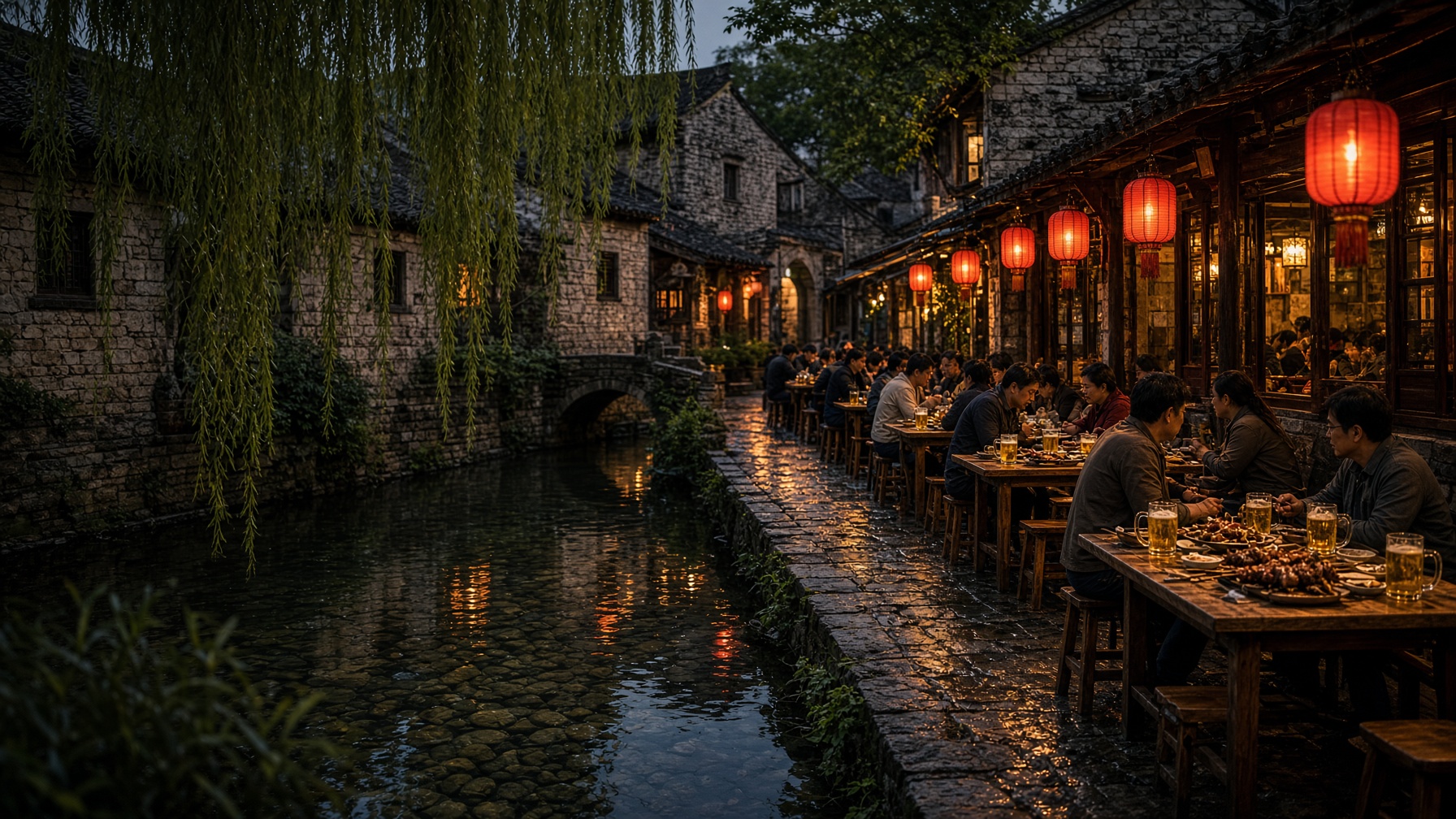
Urban drinking places are often treated as background to the night economy rather than as mappable infrastructure. From May to August 2026 we made a complete census of beer-serving venues in Lixia District, Jinan. Using market-regulation registrations, online points of interest and night walks in 13 subdistricts as a sampling frame, we field-verified 1,086 candidate sites and confirmed 412 “beerhouses” — places where beer is the first or joint-first drinking category and is served for on-site consumption. That is an order of magnitude above the “bar service” licence count (about 56). Kernel density and distance decay show that a 1 km buffer around the Baotu, Black Tiger and Pearl spring clusters holds 252 venues (61.2%); distance to the springs still predicts density after commercial floor area and night-light intensity are controlled (p < 10⁻⁴). The type spectrum has seven parts: barbecue beerhouses 168, scenic beer stalls 71, craft taprooms 64, industrial draught chains 49, lounges/pubs 42, cafe-bars 12, hotel beer gardens 6. Space splits into a dual core of “old-town spring beer” and “eastern craft beer”: the former stretches in a belt along Furong Street–Qushuiting–Kuanhouli–Yujiaqiao–the Black Tiger Spring moat, built on Baotuquan/Jinan Brewery draught and barbecue pavement seating; the latter clusters on Olympic Centre Road–Hualong Road–Hanyu Jingu, with a median glass price 2.1 times higher. Glass price correlates weakly and negatively with distance to the springs, suggesting that the spring setting itself carries a premium. We define the beerhouse as a sensor of a spring city: it records how water quality, tourist routes, night-shift labour and a local brand (Baotuquan Pure Fresh at about 100 tonnes a day) stack on the same flagstone street.
Subject: Urban night economy
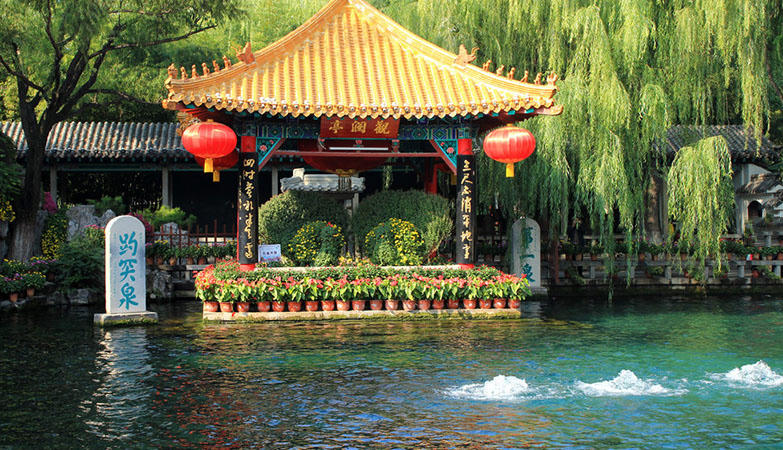
Jinan is famous as the City of Springs and equally famous for a night life in which “there is no barbecue without beer”1,2. Lixia District is the city’s administrative, cultural and commercial core: the Baotu, Black Tiger and Pearl spring clusters, Furong Street, Qushuiting Street, Baihuazhou, Kuanhouli, Quancheng Road and Henglong Plaza, and, to the east, the Olympic Sports Centre and the Hualong Road central business district all sit inside the same district line. Beer here is not a single trade. It is a continuum from scenic stalls, barbecue pavement seating, Tsingtao fresh-beer bars and Baotuquan Pure Fresh outlets, through craft taprooms such as Quancheng, Tanjin and Bole, to a roof beer garden at an InterContinental3–5. Existing urban studies either take “bars” as a night-economy indicator or treat craft beer as lifestyle consumption. Few ask a plainer question: how many beerhouses does a district actually have, how are they arranged in space, and what is their relation to spring water as a distinctive public resource.
The licence count is no help. Corporate databases list about 56 “bar service” firms in Lixia6, yet most of the places where Jinan people drink beer are registered as catering, barbecue or pre-packaged food retail. Baotuquan Pure Fresh has about 2,000 outlets citywide and sells about 100 tonnes of craft beer a day, half the municipal total3; many of those outlets sit in barbecue stalls and neighbourhood shops and will not appear on a bar list. Unless venues are defined by function, the drinking geography of a spring city is systematically underestimated.
We therefore made a complete census. The aim was not sample inference but to put every place in Lixia where beer is the leading on-site drinking category on one map, and to test a geographical hypothesis: after commercial bulk and night-time vitality are controlled, distance to the springs still predicts beerhouse density. If it holds, spring water is not only a tourist sign or a brewing source, but a spatial organizer of the night economy.
An operational definition and the census result
We define a “beerhouse” as a place that meets three conditions at once: (i) it serves beer (bottle, can, draught or kegged craft) to on-site drinkers; (ii) beer is first or joint-first in drinks sales or in beer-list exposure; (iii) it has stayable seats or pavement seating, not a pure retail shelf. Convenience-store freezers, delivery-only bottle shops, and nightclubs whose lead drinks are cocktails or baijiu were excluded. The candidate frame had three layers: market-regulation licences (bar service, catering, alcohol retail), Gaode and Meituan points of interest (bar, beer, barbecue, tavern, fresh beer), and walking supplements in 13 subdistricts between 18:00 and 23:30. From 12 May to 3 August 2026 two researchers independently verified 1,086 candidate sites; disagreements went to a third arbiter. The final set is 412 venues, with Cohen’s κ = 0.86.

The 412 venues are highly uneven across 13 subdistricts (Table 1). Quancheng Road (86), Baotu Spring (54) and Daming Lake (47) together hold 45.4% of the district. Eastern Zhiyuan and Longdong have only 5 and 11. The kernel-density peak sits inside the “Quancheng Road box” of Furong Street–Qushuiting–Bianzhi Alley–Kuanhouli; a second peak runs along the Black Tiger Spring moat–Liberation Pavilion–Yujiaqiao; a third is on Olympic Centre Road–Hualong Road. Moran’s I = 0.41 (p < 0.001); spatial autocorrelation is significant.
| Subdistrict | Beerhouses | Share of district | Density (km⁻²) | Leading types |
|---|---|---|---|---|
| Quancheng Road | 86 | 20.9% | 142 | Scenic stall / lounge / BBQ |
| Baotu Spring | 54 | 13.1% | 98 | BBQ / draught |
| Daming Lake | 47 | 11.4% | 76 | Scenic stall / craft |
| Dongguan | 38 | 9.2% | 61 | BBQ / pub |
| Jiefang Road | 35 | 8.5% | 48 | Moat BBQ belt |
| Jianxin | 29 | 7.0% | 22 | Neighbourhood BBQ |
| Wendong | 27 | 6.6% | 18 | Campus pubs |
| Qianfoshan | 24 | 5.8% | 15 | Dining with beer |
| Yanshan | 22 | 5.3% | 12 | Neighbourhood BBQ |
| Dianliu Xincun | 18 | 4.4% | 14 | Neighbourhood BBQ |
| Yaojia | 16 | 3.9% | 6 | Olympic craft |
| Longdong | 11 | 2.7% | 3 | CBD pubs |
| Zhiyuan | 5 | 1.2% | 1 | CBD craft |
| Total | 412 | 100% | — | — |
Seven types, two urban logics
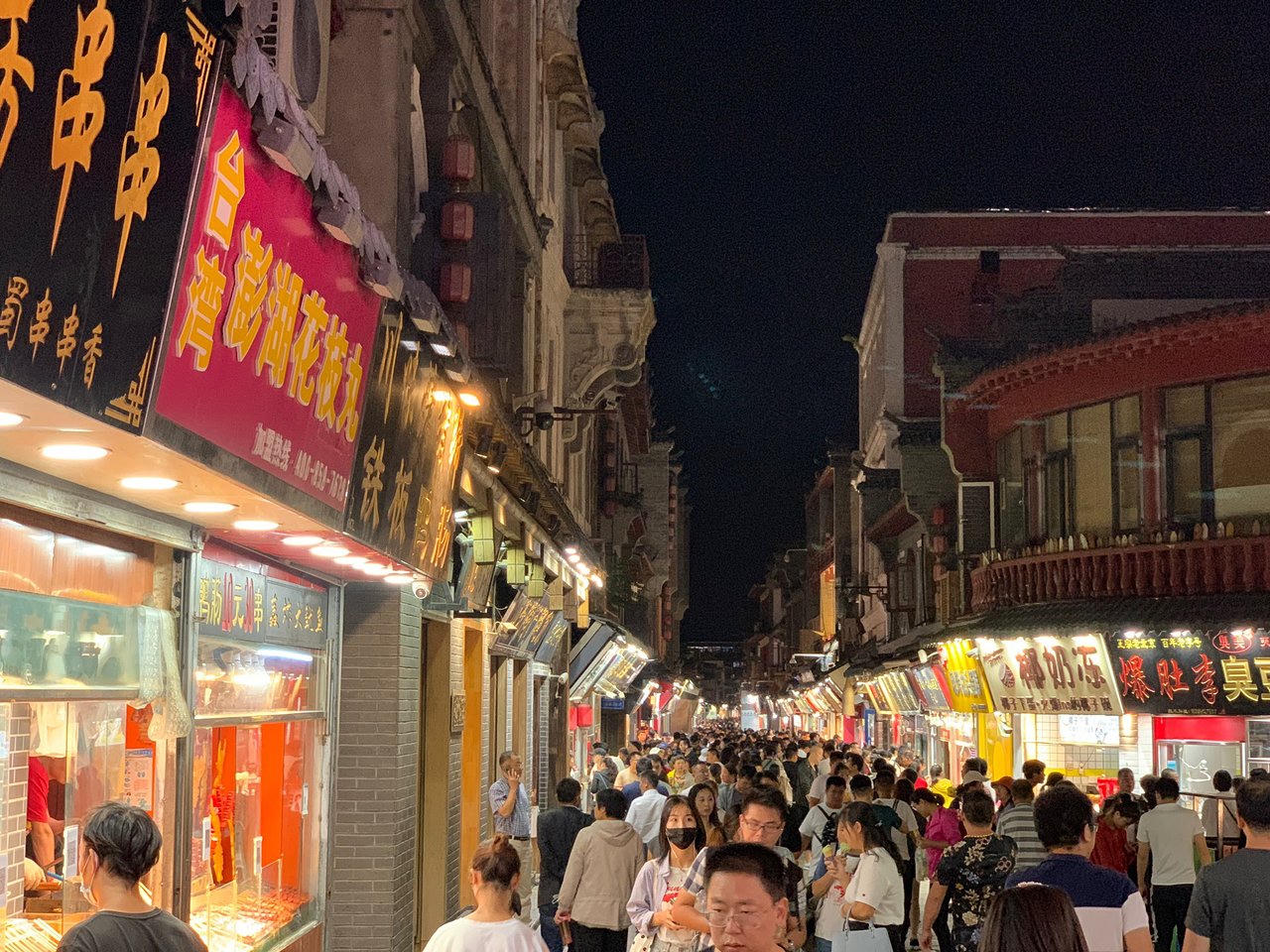
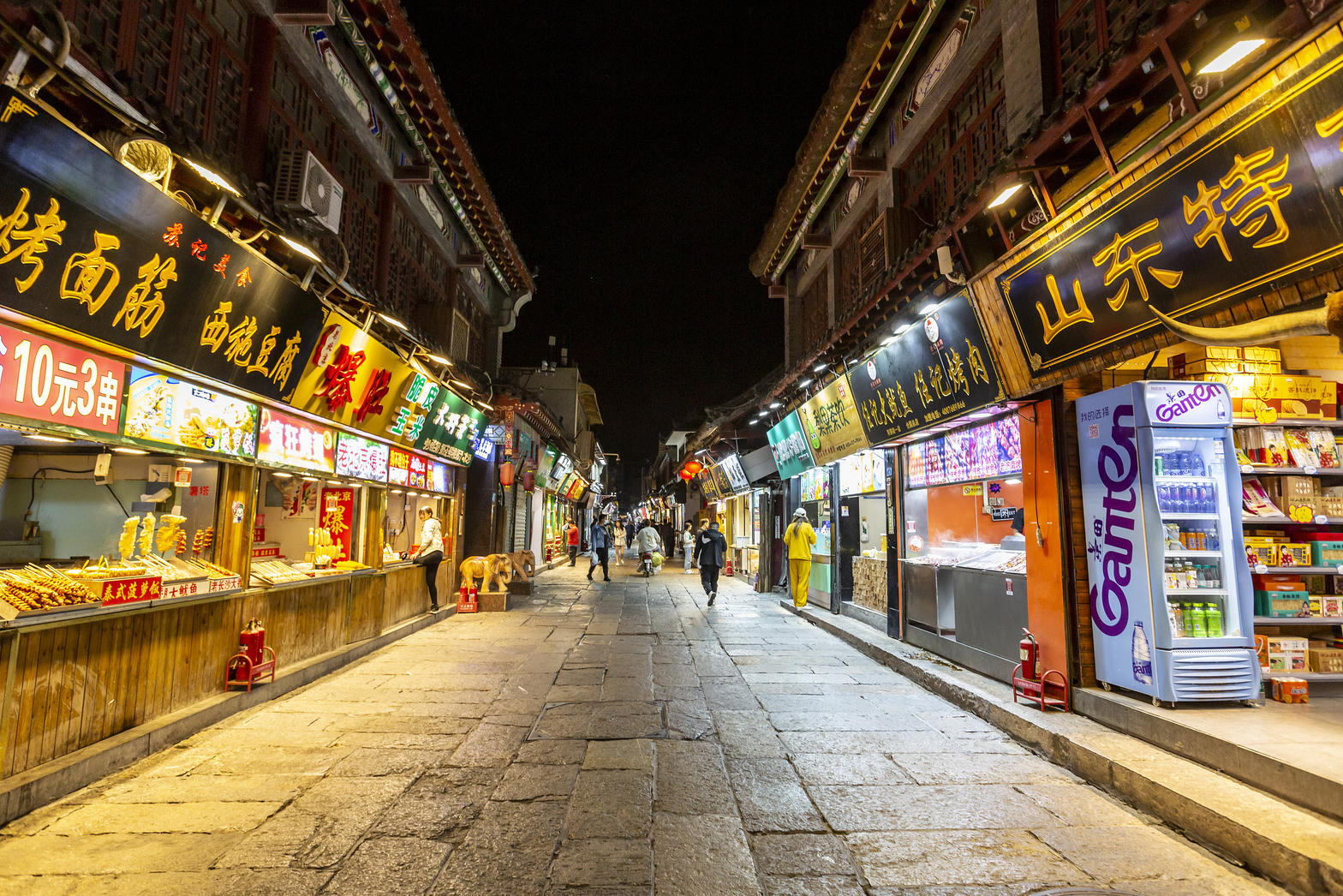
By beer-list structure, spatial form and price band, the 412 venues fall into seven types (Fig. 2). Barbecue beerhouses number 168 (40.8%), the numerical majority and the material basis of Jinan’s “skewer capital” story1: lamb skewers, edamame and peanuts with iced draught, pavement seating along street or river. Scenic beer stalls number 71 (17.2%), dense on Furong Street, Qushuiting Street, Baihuazhou and Spring in Jiuli — typically “Jishui zhi Nan Craft Beer” on Furong Street or “Jinan Brew Four-Flavour Tavern” on Qushuiting, selling German-style pale, Hoegaarden-style wheat and fruit craft under licence from Jinan Brewery Group, often below 3.5% ABV and sold as a summer drink1. Craft taprooms number 64 (15.5%), including Quancheng Craft on Heping Road, Tanjin LAB on Shanda Road, Huli on Olympic Centre Road, Bole at Baigongji on Hualong Road, Romance Craft on Lishan Road and Zhima Craft near Daming Lake; lists are dominated by kegged IPA, sour and stout, with glass prices of 18–48 yuan. Industrial draught chains number 49 (11.9%): Tsingtao Fresh Beer Bars on Yaotou Road, South Shanda Road and Zhonghai Tianyuefu, with Baotuquan Pure Fresh nested more widely in barbecue and catering. Lounges/pubs number 42 (10.2%), such as Dabing’s Cabin in Kuanhouli, Lianzhi in Bianzhi Alley, CC Club at Huate Plaza, Parachute Tower Pub at Lushang Plaza and Night Brewery in Korea Town. Cafe-bars number 12, concentrated in Hefangli (Jiumu Cafe & Bar) and Spring in Jiuli. Hotel beer gardens number only 6, including the roof garden of the Luneng Guihe InterContinental on Tianditan Street7.
Types do not overlay at random in space. Barbecue beerhouses and scenic stalls follow the springs, the moat and the flagstone streets, forming a walkable “drink-the-route” corridor; craft taprooms jump toward the eastern business district and university roads, coupled to offices, apartments and parking. Median glass prices: scenic stall 12 yuan, barbecue draught 8–15 yuan, draught chain 10–18 yuan, craft taproom 32 yuan, hotel garden 58 yuan. The median glass in the eastern craft core is 2.1 times that of the old-town spring core. We call the structure a dual core: the old town sells a spring setting and low-strength draught; the east sells a beer-list narrative and a night-time office population.
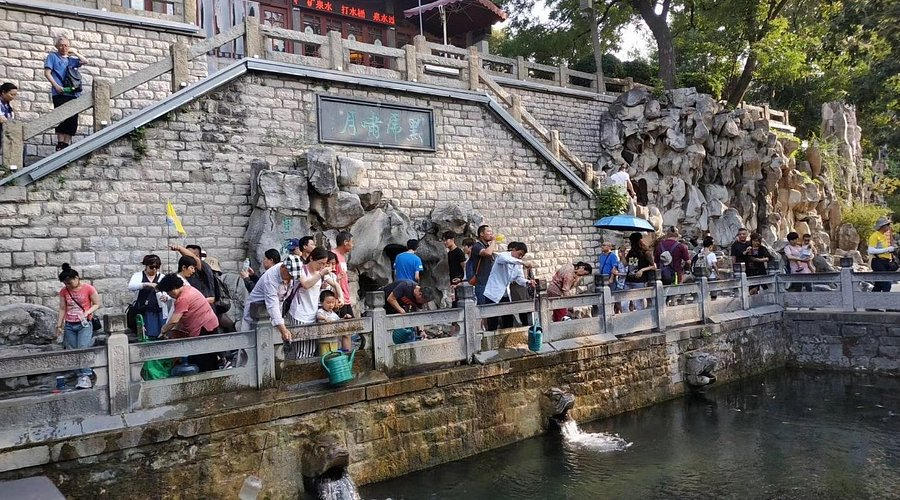
Distance to the springs independently predicts density
Of Jinan’s famous springs, the Baotu, Black Tiger and Pearl clusters lie mainly in Lixia8. With the three emergence points as centres, a 1 km buffer covers 252 beerhouses (61.2%) while occupying only about 22% of built-up area. The 0–0.5 km ring holds 148, 0.5–1 km holds 104, then counts decay rapidly (Fig. 5). A negative-exponential fit gives λ = 0.92 km⁻¹ (R² = 0.94).
Commercial floor area, POI density and NPP-VIIRS night lights all predict catering density, so the spring effect might only be a proxy for the centre. We ran a negative-binomial regression with the subdistrict as the unit; after those three controls and a dummy for adjacency to Shandong University’s central campus, distance to the nearest spring cluster remained significant (β = −0.47, s.e. = 0.11, p = 3.4×10⁻⁵). When the dependent variable is the number of craft taprooms, the spring coefficient weakens and the eastern CBD dummy strengthens; the reverse holds for barbecue beerhouses. Springs organize a particular form of drinking, not all night-time consumption.
Glass price correlates weakly and negatively with distance to the springs (Spearman ρ = −0.18, p = 0.002): nearer the water, the more likely the sale is low-strength draught and scenic pints, yet stalls branded “spring-water craft” can still sell 10–15 yuan fruit wheat to tourists. The premium is the setting, not the body of the beer. Xiaohe Renjia at Yujiaqiao is an extreme case of the mechanism — pavement seating pressed against the spring is itself the commodity1.
Local brands, festivals and night-economy routes
Beer-list records during the census show that 42% of venues serve at least one Jinan beer (Baotuquan, Jinan Brew craft, Quancheng or the D17 system), 28% serve Tsingtao draught, and craft shops widely bring in Jing-A, Dao Brewing, Chumen, Wumu and other out-of-town brands. Baotuquan Pure Fresh writes the spring narrative as process: since 2019 it has turned to craft on a spring-culture story, selling about 100 tonnes a day in peak season3. Spring water here is at once raw material, trademark and street furniture.
The July 2025 craft-beer festival on the mid-street of Henglong Plaza, north of the spring monument, drew more than 360,000 visits in three days4,5, temporarily suturing the dual core of the census: eastern beer lists and old-town crowds met on Quancheng Road. The Furong Street–Kuanhouli–Quancheng Square route coincides with the density ridge of beerhouses; that is not an accident. Instant footfall peaks between 19:00 and 22:00 (we installed seven-day infrared counters at 40 sites) align with spring night tours and moat lighting hours9. The beerhouse is a stop on that route.
| Venue | Location | Type | Notes |
|---|---|---|---|
| Jishui zhi Nan Craft Beer | Furong Street | Scenic beer stall | Licensed by Jinan Brewery Group; low-ABV fruit wheat |
| Jinan Brew Four-Flavour Tavern | Qushuiting Street | Scenic beer stall | German-style, wheat, Jinan Pilsner |
| Xiaohe Renjia | Yujiaqiao | BBQ beerhouse | Spring-side seating; Baotuquan draught |
| Dabing’s Cabin | Kuanhouli | Lounge / pub | Chain tavern; late hours |
| Lianzhi | Bianzhi Alley | Lounge / pub | Old-town lane lounge |
| Quancheng Craft | Heping Road | Craft taproom | Local craft; festival mainstay |
| Tanjin LAB | Shanda Road | Craft taproom | Campus–city interface |
| Bole Craft | Baigongji, Hualong Road | Craft taproom | World list; eastern core |
| Romance Craft | Lishan Road | Craft taproom | Paired with Caobao bun shop |
| Zhima Craft | Near Daming Lake | Craft taproom | Value craft; order of a hundred glasses a day |
| Huli Craft Bar | Olympic Centre Road | Craft taproom | Olympic business belt |
| Tsingtao Fresh Beer Bar | Yaotou Road and others | Industrial draught chain | Multi-site standardized draught |
| Parachute Tower Pub | Lushang Plaza | Lounge / pub | Mall night-time anchor |
| CC Club | Huate Plaza | Lounge / pub | Performance pub |
| Night Brewery | Korea Town | Lounge / pub | Theme tavern |
| Jiumu Cafe & Bar | Hefangli | Cafe-bar | Block-renewal sample |
| InterContinental Roof Beer Garden | Tianditan Street | Hotel beer garden | 12th floor; overlooks the City of Springs |
| MixSkyPub | Lixia | Lounge / pub | Nightclub–tavern transition |
Discussion
Once 412 beerhouses are set back onto spring geography, Lixia’s night economy is no longer a stack of “mall plus bar”. Spring water supplies three mutually reinforcing functions: as brewing water, it underwrites the material authenticity of Baotuquan and spring-water craft10; as an accessible public water surface, it legalizes and scenicizes pavement seating; as a tourist sign, it turns the low-strength beers of Furong Street and Qushuiting into a drink that can be photographed. The three functions overlay at the 1 km scale and produce a nonlinear pile-up of density. The eastern craft core shows that beerhouses can still grow once they leave the springs, but they must change the commodity: from setting to beer list, from draught to IPA.
Methodologically, the gap between a functional definition and a licence definition (412 against about 56) warns users of urban data: points of interest or business statistics keyed on “bar” will systematically delete the leading drinking form of a North China city — the barbecue beerhouse. For the night economy, alcohol harm or small-firm policy, that deletion is not noise.
The study has clear bounds. The census is a summer 2026 cross-section; winter contraction of pavement seating may shift type shares. Lixia does not stand for Huaiyin, Shizhong or Tianqiao (the D17 site is in Tianqiao). We did not measure individual intake, so venue density cannot be read directly as alcohol exposure. Even so, as a complete-sample map it supplies a denominator that later work in health, planning and branding can share.
If the beerhouse is treated as a sensor of a spring city, the next step is to put water quality, ions in the glass and beer-list brands on one panel: which spring, which beer, which street are consumed together on the same night. That would be an object truly shared by brewing science and urban science.
Methods
- The study area is the current administrative boundary of Lixia District, Jinan (13 subdistricts: Quancheng Road, Baotu Spring, Daming Lake, Jiefang Road, Dongguan, Wendong, Jianxin, Qianfoshan, Yanshan, Dianliu Xincun, Yaojia, Longdong and Zhiyuan).
- Candidate frame: going concerns in Lixia published by the Shandong Administration for Market Regulation (scope including bar service, catering or alcohol retail, retrieved to 30 April 2026); Gaode Maps and Meituan points of interest for May 2026 (keywords: bar, beer, fresh beer, craft, barbecue, tavern, lounge); night walking supplements in 13 subdistricts (at least one weekday and one weekend each).
- Inclusion criteria as in the main text. Two researchers independently verified sites in the field, recording coordinates (handheld GNSS, nominal accuracy 3 m), type, first brand on the list, posted price of a small draught (about 330–500 mL), seats and pavement seating, and whether a spring or the moat was visible. κ = 0.86.
- Spring-cluster locations follow official Jinan Famous Springs coordinates (emergence centres of Baotu, Black Tiger and Pearl). Kernel-density bandwidth 400 m. Negative-binomial regression uses the subdistrict as the unit; controls are commercial floor area from the 2024 building census, 2025 POI catering density, and the 2025 annual mean of NPP-VIIRS night lights.
- Forty infrared footfall counters ran continuously from 7 to 13 July 2026 at 15-minute resolution.
- Ethics: observation of public façades and published beer lists only; no consumer identities collected. Shandong University ethics filing SDU-IRB-2026-031.
Data availability. De-identified venue points (precision blurred to 100 m), types and price bands are released as Supplementary Data 1; exact addresses are withheld for operator privacy. Raw footfall series are in Supplementary Data 2.
Acknowledgements. We thank the Lixia Administration for Market Regulation for assistance with public data interfaces, and the Sino-German Beer Technology Centre at Qilu University of Technology for comparative tastings. Twelve graduate volunteers from Shandong University supported the walking verification. This work was supported by NSFC 42301267 and Shandong Social Science Planning 24CLYJ08.
Author contributions. Z.B.C. and L.S.Y. jointly designed the study and contributed equally. Z.B.C., L.S.Y. and Z.Y.N. led the field census. M.C.Y. conducted spatial statistics and regression. C.G.Y. developed the typology and ethnographic comparison. S.K. contributed the third-place theoretical frame. Z.B.C. and M.C.Y. drafted the paper. All authors reviewed and approved the final manuscript.
Competing interests. The authors declare no competing interests.
Authors and affiliations
- 1. School of History and Culture, Shandong University, Jinan, China
- 2. Institute of Cultural Heritage, Shandong University, Qingdao, China
- 3. Sino-German Beer Technology Centre, Qilu University of Technology (Shandong Academy of Sciences), Jinan, China
- 4. Institute of Geographic Sciences and Natural Resources Research, Chinese Academy of Sciences, Beijing, China
- 5. School of Business, Shandong University, Jinan, China
- 6. School of Culture and Tourism, University of Jinan, Jinan, China
- 7. Institute for Research in Humanities, Kyoto University, Kyoto, Japan
Corresponding author: Bochun Zhang (bzhang@sdu.edu.cn); Chengyuan Ma (cyma@igsnrr.ac.cn)
References
- 1. Zhang, S. The beer world of the ‘skewer capital’. Shandong Business Daily (5 July 2024).
- 2. Ocejo, R. E. Masters of Craft: Old Jobs in the New Urban Economy (Princeton Univ. Press, 2017).
- 3. Guan, Y. & Shi, S. Jinan locals drink 200 tonnes of craft beer a day. Qilu.com (11 July 2025).
- 4. Uncompromising Ski. The 2025 Jinan Craft Beer Festival opens at Henglong Plaza. Luwang (10 July 2025).
- 5. Jinan Craft Beer Festival ignites a City of Springs summer night: 360,000 visits in three days. Local reports (July 2025).
- 6. Qichamao. Summary of bar-service firm registrations in Lixia District, Jinan (2023).
- 7. Roof beer garden opens at Jinan Luneng Guihe InterContinental. Meet Shandong (21 May 2025).
- 8. Wang, Y. et al. Hydrochemistry of the Jinan spring catchment and the spatial structure of famous springs. Hydrogeol. Eng. Geol. 46, 1–10 (2019).
- 9. Autumn dusk comes early; night banquets open on the lake. Dazhong.com Shandong (September 2026).
- 10. Yu, T. et al. Oral history of Baotuquan beer and spring-water process. Qilu Evening News (2023).
- 11. Oldenburg, R. The Great Good Place (Da Capo, 1999).
- 12. Thurnell-Read, T. Craft beer and belonging. Sociology 55, 784–802 (2021).
- 13. Florida, R. The Rise of the Creative Class (Basic Books, 2012).
- 14. Shaw, R. Beyond night-time economy: affective atmospheres of the urban night. Geoforum 51, 87–95 (2014).
- 15. Hadfield, P. Bar Wars: Contesting the Night in Contemporary British Cities (Oxford Univ. Press, 2006).
- 16. Briggs, D. E., Boulton, C. A., Brookes, P. A. & Stevens, R. Brewing: Science and Practice (Woodhead, 2004).
- 17. Eumann, M. & Schildbach, S. 125th anniversary review: water in brewing. J. Inst. Brew. 118, 2–9 (2012).
- 18. Borer, M. I. The politics of snacks and the taste of place. City & Community (2019).
- 19. Jinan Municipal People’s Government. Administrative divisions of Lixia District and the famous-springs protection list (2024).
- 20. Mozny, M. et al. The impact of climate change on hops. Agric. For. Meteorol. 149, 1308–1315 (2009).
- 21. Bellut, K. & Arendt, E. K. Dealcoholized beer. Beverages 5, 25 (2019).
- 22. Liu, M. et al. Spatial organization of the night-time economy in Chinese cities. Acta Geogr. Sin. 76, 204–220 (2021).
- 23. D17 Cultural and Creative Industrial Park. Adaptive reuse of the Baotuquan brewery industrial heritage (2023).
- 24. Mehta, V. The Street: A Quintessential Social Public Space (Routledge, 2013).